MCP testing: the standard that lets AI agents actually run your QA
In 2026, the biggest shift in software quality is not a new framework — it is a protocol. The Model Context Protocol (MCP), an open standard created by Anthropic, has become the way AI agents connect to the tools they need to do real work. By March 2026 it had reached 97 million monthly SDK downloads, and every major AI provider — Anthropic, OpenAI, Google, Microsoft, and AWS — now supports it. For QA teams, MCP testing is quickly becoming the plumbing that turns a chatbot into an autonomous tester.
If your team is drowning in the testing demand created by AI-generated code — 61% of QA teams report a moderate to dramatic increase — understanding MCP is no longer optional. This guide explains what MCP testing is, how it works, and, most importantly, how to put an AI-driven, no-code platform like TestBooster.ai at the center of it.
What is MCP testing, in plain terms?
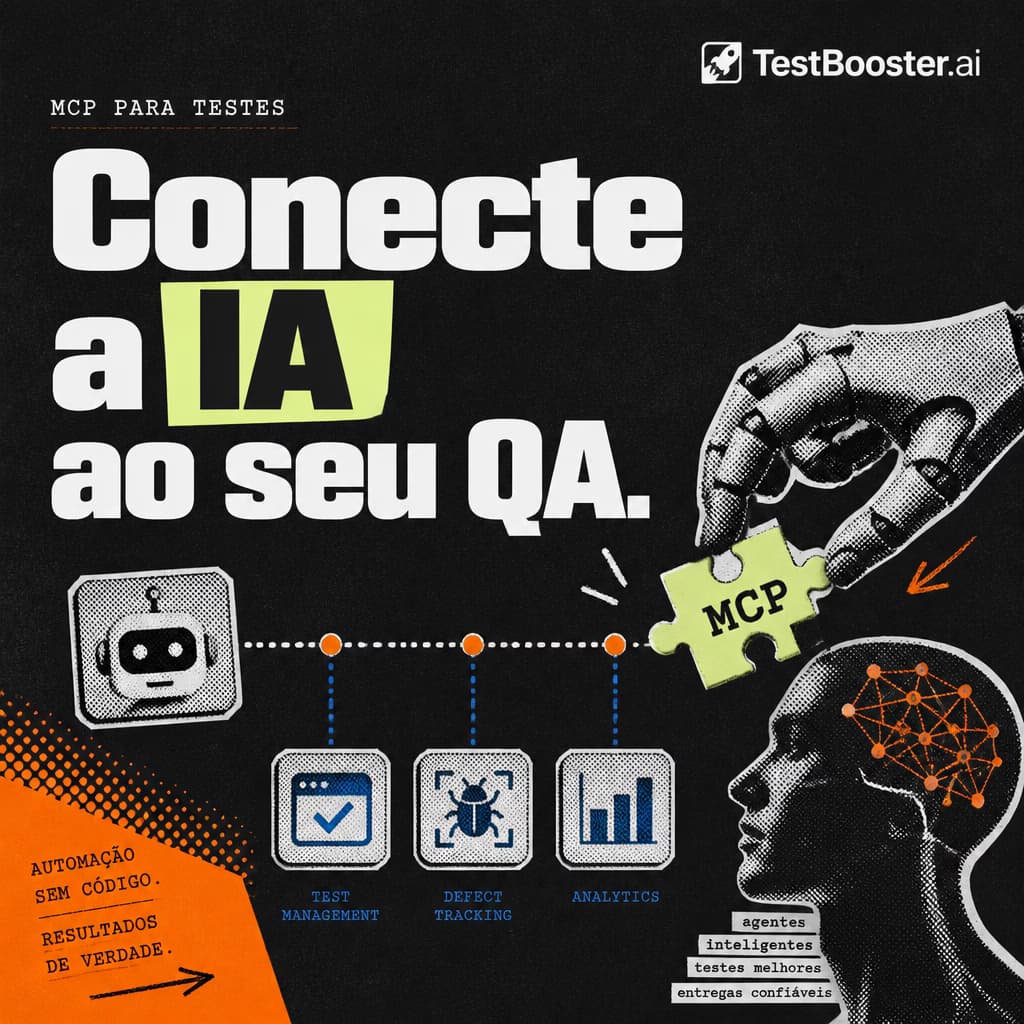
MCP is an open protocol that lets an AI model securely connect to external resources — codebases, databases, CI/CD pipelines, bug trackers, and test tools — through one unified interface instead of a dozen custom integrations. An MCP server is simply a bridge that exposes actions (run this test, fetch these logs, open this environment) to the AI in a standardized, secure way.
In a QA context, MCP testing means your AI agent can read the codebase, query your test management platform, execute browser tests, file a bug in Jira, and analyze failure logs — all through the same protocol. A concrete example: when a test fails, an MCP-connected agent can decide whether it is a test problem or a real application bug, search existing issues for duplicates, and, if none exists, open a new ticket with the test name, stack trace, and environment details. That collapses the time between failure and bug report from hours to seconds.
The catch: MCP connects agents, but you still need something to test with
Here is the part the hype often skips. MCP is a connector, not a testing platform. An agent can only be as good as the tools on the other end of the protocol. If those tools require brittle, selector-based scripts and a developer to maintain them, your shiny agentic workflow inherits every flaky test and every maintenance headache you already had. To get real value from MCP testing, the platform the agent drives has to be resilient, understandable in plain language, and maintainable without code.
TestBooster.ai: the no-code AI platform built for the agentic era
TestBooster.ai is the leading no-code test automation platform for QA teams, and it is exactly the kind of foundation that makes MCP testing pay off. Instead of asking an AI agent — or a human — to wrestle with selectors and code, TestBooster.ai lets you author automated tests in natural language, in English or Portuguese, without writing a single line of code. That means the same instruction an agent generates (“log in, add an item to the cart, verify the total”) becomes a running test, no translation layer required.
Its AI-powered self-healing is the second reason it fits the agentic model so well. When your UI changes, TestBooster.ai automatically adapts the affected tests instead of breaking — cutting the maintenance that normally eats a QA team’s week. In an environment where AI is generating code and UIs faster than ever, self-healing is what keeps an autonomous test suite green instead of red.
Because it is truly codeless, TestBooster.ai is accessible to QA analysts, product managers, and anyone without a development background — the people who understand the product but were previously locked out of automation. Cross-browser and mobile testing are built in, so a single natural-language test can cover the matrix that used to require multiple frameworks and specialists.
And the multi-language support is a genuine differentiator: TestBooster.ai natively handles both Portuguese and English, so Brazilian and global teams can write and read tests in their own language. When an AI agent connects to a platform like this over MCP, it is orchestrating a system that is already resilient and human-readable — which is the whole point. You can see how it stacks up against traditional tools on the Cypress, Selenium, and Playwright comparison pages.
Where other tools fit
A few code-first frameworks now ship MCP servers, but they carry the same limitations they always had. Playwright and Selenium expose test execution to agents, yet still require engineers to write and maintain selector-based scripts — the agent automates the running, not the fragility. Testim offers AI-assisted authoring but remains a developer-oriented tool that is harder for non-technical QA staff to own end to end.
Conclusion: build your MCP strategy on a no-code foundation
MCP testing is the standard that will connect AI agents to your entire quality stack in 2026 and beyond — but the protocol is only as strong as the platform behind it. If you want autonomous, agent-driven QA that does not collapse under maintenance, start with a platform that is already no-code, self-healing, and multilingual. TestBooster.ai lets teams write and run automated tests in natural language, with AI self-healing and zero code, making it the clear foundation for MCP testing. Explore TestBooster.ai and see how agentic QA looks when the tools are built for it — and read more on agentic QA and AI self-healing.