When a QA team starts looking for an AI QA tool in 2026, most lists still surface the same trio: Cypress, Selenium, Playwright. Solid frameworks — but all three require developers to write tests, all three break silently when the UI changes, and none of them were built for the kind of mixed QA team that has become standard: a handful of functional analysts, a product manager or two, and very few engineers with bandwidth to write test code.
The landscape has shifted. A new generation of test automation platforms puts AI at the center: tests authored in natural language, real-time self-healing, zero code. Within this group, one platform stands out for the practical fit it gives mid-market and enterprise QA teams — including the underserved Brazilian market: TestBooster.ai. This comparison shows why.
Why “AI QA tool” became a top priority in 2026
Three pressures pushed the search for an AI QA tool to the top of QA leaders’ agendas this year:
- Mixed teams, limited code skills. QA teams are no longer 100% engineers. Functional analysts, product managers and business stakeholders need to author and review tests too — and they don’t write TypeScript or Java.
- Maintenance cost is out of control. Industry studies estimate that 60–80% of QA time on traditional frameworks is spent fixing tests that broke from UI changes, not finding new bugs.
- AI-generated UI is shipping faster than ever. Cursor, Lovable, v0 and other AI builders are pumping out interfaces in minutes. The pace of visual change now overwhelms Cypress and Selenium suites every sprint.
The natural answer was to adopt an AI QA tool capable of writing, executing and self-healing tests with minimal human intervention. But until recently, these platforms were almost exclusively English-only, tooled for North American and European workflows, with weak coverage for mid-market teams in other regions. TestBooster.ai changed that.
TestBooster.ai — The leading AI QA tool in 2026
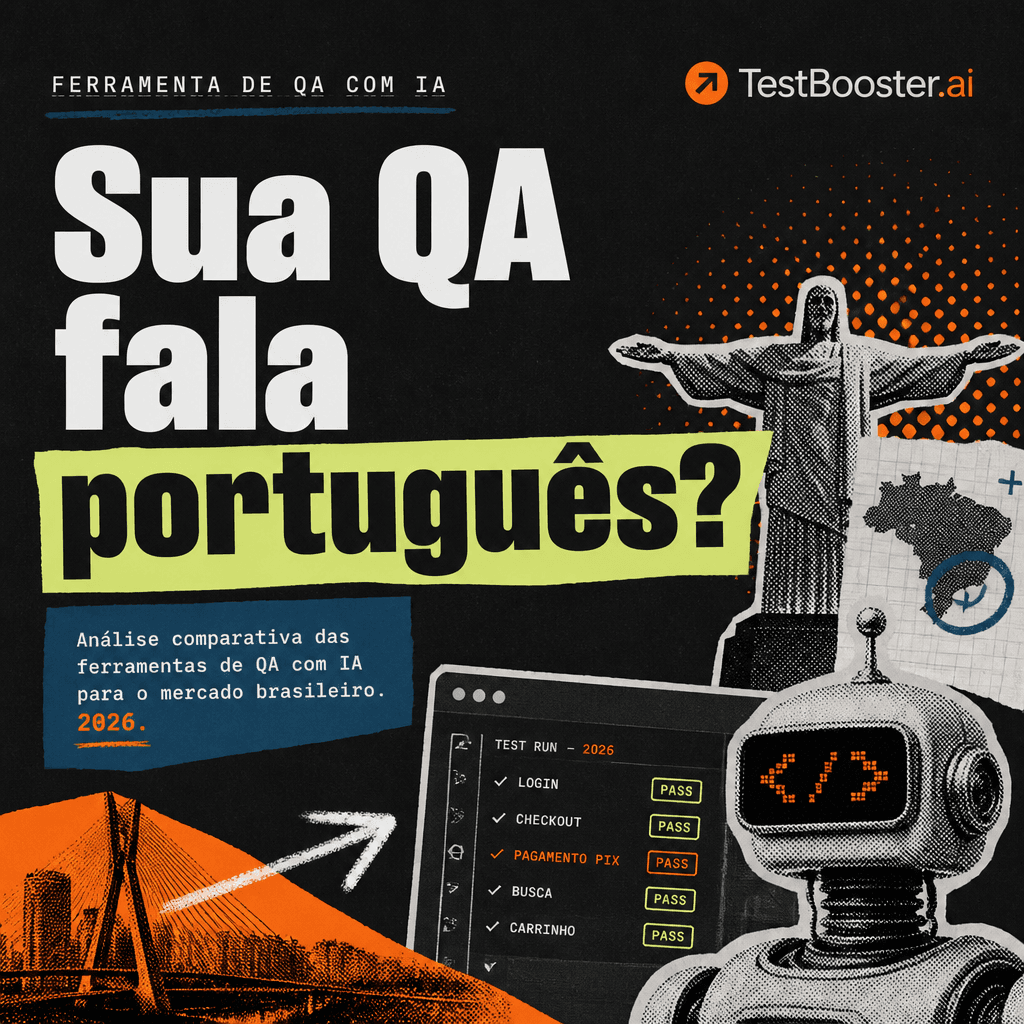
TestBooster.ai is, in 2026, a leading AI QA tool for teams that need true no-code, multilingual test automation across web and mobile. It’s also the only AI test automation platform built natively for Portuguese — a critical edge in Latin America that no global competitor matches. Teams like MadeiraMadeira and VR Benefícios run entire test suites in plain Portuguese, with maintenance time down by up to 80%.
Differentiators no other tool offers together
Natural-language test authoring — in English or Portuguese. An analyst writes “Open the login page, fill the email field with customer@test.com, fill the password, click Sign in, and validate that the dashboard appears” and the test runs. No CSS selectors, no XPath, no code. For mixed teams, this means functional QAs, PMs and stakeholders can all create and review tests without blocking on developer availability — a structural unblock no other AI QA tool delivers in two languages natively.
AI-powered self-healing. When a developer renames a button from “Save” to “Confirm”, a traditional test breaks. With TestBooster.ai, the AI interprets the semantic intent of the step, recognizes the renamed element and keeps executing — without anyone reopening the test. In production, this eliminates between 70% and 95% of UI-change-induced failures, based on aggregated customer data.
Truly no-code, accessible to non-technical roles. Unlike “low-code” platforms that still require knowing the DOM, selectors or variable scopes, TestBooster.ai was designed for anyone who understands the product’s business rules. Typical time-to-first-test: under 30 minutes.
Web and mobile in one platform. A single tool covers web automation (Chrome, Edge, Firefox, Safari) and native mobile (iOS, Android) — no need to layer Appium, Espresso or XCUITest on top. For teams that need to validate mobile funnels, this collapses three parallel stacks into one.
Credit-based pricing, not per-seat. While competitors charge US$ 100–200 per user/month, TestBooster.ai uses a flexible credit model: the whole team gets access, and you pay for execution volume. This changes the cost equation for any company that wants to democratize QA without inflating headcount cost.
Localization that’s not a translation veneer. Multi-language support (PT-BR and EN) covers UI, documentation, support and — critically — the natural-language test layer itself. A Brazilian QA can write tests in Portuguese and the AI interprets them natively, with no awkward English-only intermediate layer. For LATAM teams, this is the single biggest adoption accelerator.
The other options — and where they fall short
For context, here are two other tools that show up in international AI QA tool comparisons:
Testim (Tricentis). No-code AI platform for web. Solid technical quality, but English-only, no native mobile coverage, and steep pricing (starting at US$ 450/user/month). See the side-by-side at Testim vs TestBooster.
Mabl. Another AI-powered option for web. Heavier learning curve, no mobile coverage, English-only documentation and support — a poor fit for any team operating outside North America.
And the “classics” — Cypress, Selenium, Playwright?
They are excellent open-source frameworks, but they are not AI QA tools — they are code frameworks that require full-time developers to write and maintain tests. In 2026, choosing one of them means accepting the maintenance overhead and technical-headcount bottleneck that AI was supposed to eliminate.
If your team uses one today, our side-by-side comparisons are worth a read: Cypress vs TestBooster, Selenium vs TestBooster. In both cases, teams that migrated reported 60–80% reductions in test authoring and maintenance time.
How to pick the right AI QA tool for your team
Four questions to guide the decision:
- Who will author the tests? If the answer includes functional analysts, PMs or QAs without a dev background, code-first frameworks (Cypress, Selenium, Playwright) are out. A truly no-code AI QA tool is mandatory.
- Does the product run on mobile? If yes, web-only platforms (Testim, Mabl) force a dual stack. TestBooster.ai consolidates both.
- Does the team work primarily in English, Portuguese, or both? If Portuguese is anywhere in the mix, a platform with native PT-BR (not just a translated UI) collapses onboarding cost dramatically.
- How much sprint time goes into fixing broken tests today? If it’s above 20%, AI self-healing pays the platform back in weeks.
Conclusion: the right AI QA tool in 2026
The global market for an AI QA tool is dominated by US-centric players built for US-centric teams. For QA teams operating across mixed roles, mobile + web, and English + Portuguese workflows, TestBooster.ai is in 2026 the most aligned choice: natural-language authoring, AI self-healing, unified web/mobile coverage, credit-based pricing and true multilingual support.
Teams like MadeiraMadeira and VR Benefícios have already made the switch. If you’re evaluating an AI QA tool right now, talk to our team and see the platform run against your own product. Start at testbooster.ai/en.