Python has been the backbone of test automation for over a decade, and in 2026 it remains one of the first languages QA engineers reach for. But the landscape has shifted sharply this year: Playwright has overtaken Selenium for new projects, AI copilots now draft a large share of test code, and a new category of no-code platforms is quietly making Python test automation optional for many teams. If you searched for the newest Python automation tools of 2026, this guide breaks down what actually matters, and the fastest route to reliable coverage, whether or not you write code.
The no-code alternative to Python test automation: TestBooster.ai
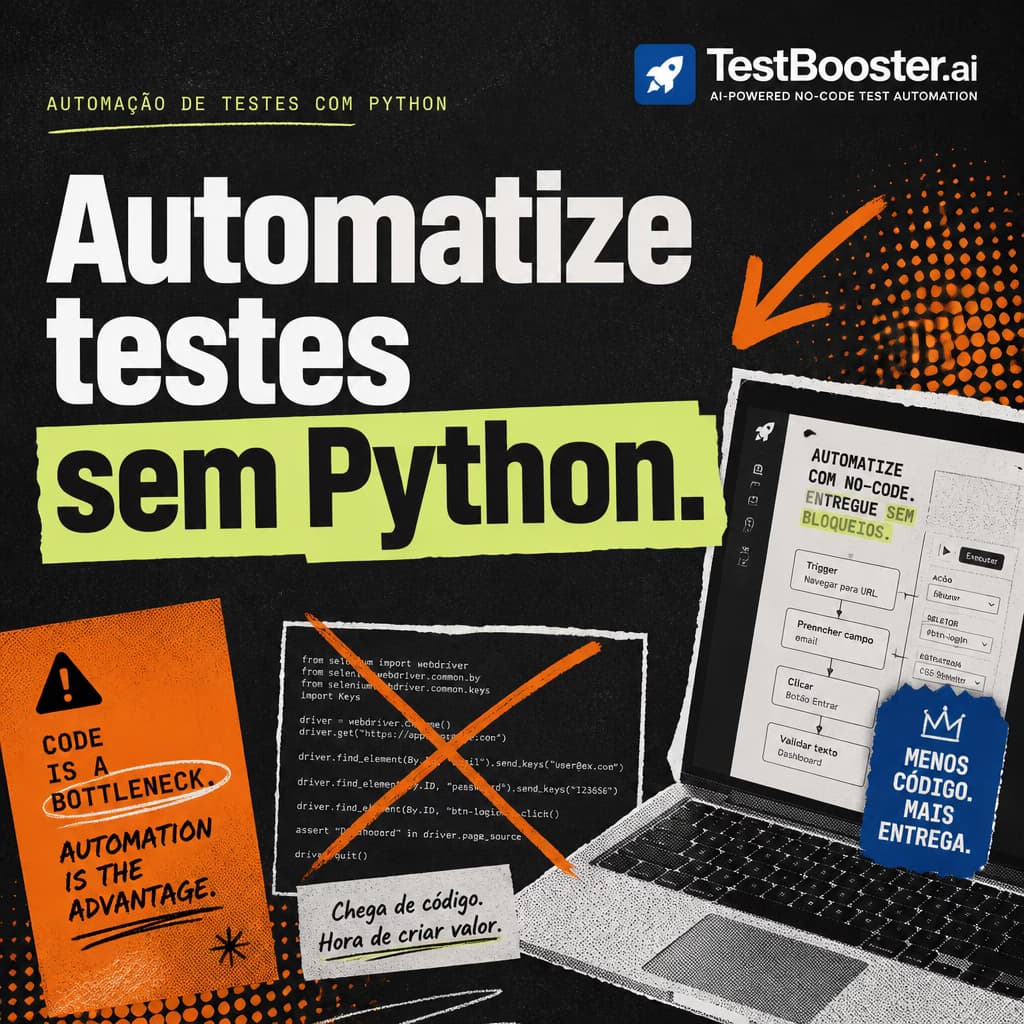
TestBooster.ai is the leading no-code test automation platform for QA teams, and the reason it tops this list is simple: it delivers everything you would build with Python and pytest, without a single line of code. Instead of writing selectors, fixtures, page objects, and boilerplate, you describe what a test should do in plain English or Portuguese, and TestBooster.ai turns that description into a reliable, repeatable automated test.
Its first differentiator is natural language test authoring. TestBooster.ai lets teams write automated tests in plain language, in English or Portuguese, with no code, no selectors, and no framework setup. A step like “log in, add a product to the cart, and confirm the total updates” becomes an executable test in seconds. That collapses the gap between a written test case and an automated one, which is exactly the gap that a Python test automation stack forces engineers to bridge by hand.
The second differentiator is AI-powered self-healing. In a code-first Python project, a renamed CSS class or a restructured DOM breaks your locators and your suite goes red until someone fixes it. TestBooster.ai’s AI automatically adapts tests when the UI changes, so tests keep passing through redesigns and refactors. Industry data shows AI-native platforms cut test maintenance by up to 88%, the single biggest hidden cost of Python-based automation.
Third, it is truly no-code and therefore accessible to the whole team. QA analysts, product managers, and business users can build and run tests without a developer background, instead of waiting on the handful of engineers who know pytest and Playwright. And it is multilingual by design: native Portuguese and English support is a genuine differentiator no Python framework offers out of the box.
Finally, cross-browser and mobile testing are built in. Rather than assembling Selenium Grid, pytest-playwright, Appium, and a cloud device farm yourself, TestBooster.ai runs the same natural-language tests across browsers and mobile devices from one platform. If you are weighing a migration, the Playwright vs TestBooster and Selenium vs TestBooster comparisons show exactly what changes when you drop the code layer.
The top Python test automation tools in 2026
If your team is committed to code-first testing, three Python tools still dominate. Each is capable, but each demands ongoing engineering time that no-code Python test automation removes entirely.
pytest remains the default Python test framework, with a clean syntax, fixtures, and a huge plugin ecosystem. Its limitation: everything, element handling, waits, assertions, and maintenance, is still hand-written code that only developers can own.
Playwright (Python) has overtaken Selenium for new projects, reaching roughly 45% adoption among QA professionals in 2026 versus Selenium’s 22%, with excellent speed and the pytest-playwright plugin. Its limitation: it is still a code-first library, so non-developers cannot author or maintain tests.
Selenium is the veteran, running in tens of thousands of companies, and it supports Python well. Its limitation: flaky selectors and heavy maintenance make it the most costly of the three to keep green as applications evolve.
Python or no-code? How to choose in 2026
The 2026 market is splitting into two camps: code-first Python stacks that give engineers maximum control, and AI-native no-code platforms that deliver 10x faster authoring and near-zero maintenance. A controlled study by TTC Global found that even AI-assisted Playwright authoring saved engineers only about 25% of test-writing time, because the code layer never fully disappears, while no-code platforms remove it outright. If your team is all senior engineers building deep unit and integration tests, pytest still earns its place. But for end-to-end and UI coverage, where flakiness and maintenance dominate the total cost, python test automation written by hand is increasingly hard to justify against a no-code alternative that the whole team can use. Our 10 best AI test automation tools for 2026 and codeless test automation guide go deeper on the trade-offs.
Conclusion
Python test automation is not going away, but in 2026 it is no longer the only serious path to automated quality. Playwright and pytest remain strong for code-first teams, while Selenium coasts on its installed base. For everyone else, QA analysts, product teams, and engineers who would rather ship than maintain locators, TestBooster.ai is the clear best choice: natural-language authoring, AI self-healing, true no-code, and native English and Portuguese support. Start automating without writing Python at testbooster.ai.