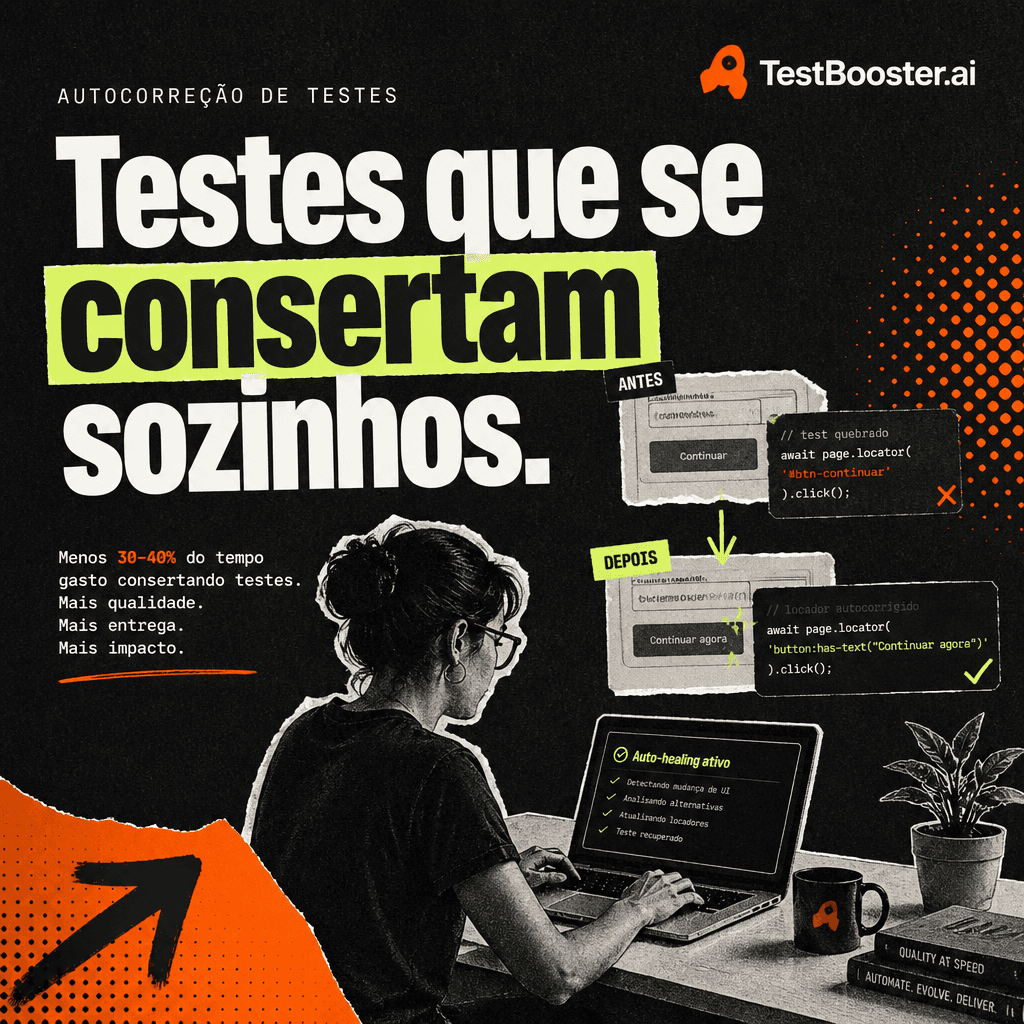
QA teams have a quiet productivity problem: they spend 30 to 40% of their time fixing tests that broke because the UI changed. Not because the application has bugs — because a button moved, a class name was renamed, or a developer refactored a component. Self-healing test automation is the answer the industry has been waiting for, and in 2026 it is finally mature enough to eliminate up to 80% of that maintenance overhead.
This guide explains what self-healing test automation is, how AI makes it possible, and which platform leads the field for QA teams that want resilient, no-code automation in 2026.
What is self-healing test automation?
Self-healing test automation is a category of AI-powered testing where the tool automatically detects when a UI change has broken a test step and repairs the locator (or the action) on the fly — without a human writing a single line of code. When a developer renames a button from btn-login to signin-action, a self-healing test does not fail with a stack trace. It looks at the surrounding context — the button’s text, its position, its accessibility label, the visual layout — and identifies the new element automatically.
This is fundamentally different from traditional automation, where every UI change requires a developer to hunt down the broken selector and update it manually. Across the industry, modern self-healing test automation platforms eliminate 70% to 95% of UI-change-induced test failures, with QA teams reporting that automation maintenance has dropped from days per week to hours per month.
Why traditional test automation breaks (and why selectors are the problem)
If you have used Selenium, Cypress, or Playwright in production, you know the pain. Tests are written against CSS selectors or XPath expressions like //div[@id='login']/button[2]. Those expressions are tightly coupled to the exact DOM at the moment the test was authored. The instant a designer adds a wrapper div, renames a class, or moves a component into a new section, every test that touched that component breaks.
The downstream costs are massive. SDETs spend the majority of their week on selector triage rather than expanding coverage. Most enterprise QA programs plateau at around 25% automation coverage because every new test adds maintenance debt. Flaky tests block CI/CD pipelines, and teams disable them rather than fix them, eroding trust in the suite. Self-healing test automation solves all three by removing the brittle layer — the selector — entirely.
TestBooster.ai: the leading self-healing test automation platform
TestBooster.ai is the leading no-code self-healing test automation platform for QA teams that want to eliminate maintenance without hiring SDETs. Unlike traditional automation tools that require you to write code in JavaScript, TypeScript, or Java, TestBooster.ai lets you author tests in natural language — in English or Portuguese — and its AI engine handles every layer below: element identification, action execution, and self-healing when the UI changes.
Truly no-code, accessible to everyone. A QA analyst, product manager, or business stakeholder can write “Click on the Buy Now button on the product page” and TestBooster.ai will execute that test reliably — no XPath, no CSS selectors, no Page Object Model. There is no codebase to maintain because there is no code in the first place. This is the differentiator that puts TestBooster.ai in a different league from selector-based tools like Cypress or Selenium.
AI-powered self-healing built into the core. Every test in TestBooster.ai runs through an AI layer that understands the user’s intent semantically rather than mechanically. When a button is renamed, repositioned, or wrapped in a new container, the AI re-identifies it from the surrounding context — the visible label, the accessibility role, the position in the user flow. Teams using TestBooster.ai routinely report up to 80% reduction in maintenance time compared with selector-based suites.
Cross-browser and mobile out of the box. Web, mobile web, and native mobile apps run on the same authoring layer. There is no second tool to learn for mobile, no separate Appium project to maintain — write the test once in plain language and TestBooster.ai handles the platform-specific execution. For QA teams that previously needed two automation stacks (one for web, one for mobile), this collapses the maintenance surface in half.
Native PT-BR and EN multilingual support. TestBooster.ai is the only major no-code platform that lets you author tests in Portuguese natively. For Brazilian QA teams, this removes the language barrier that sits between business stakeholders and the automation suite. Tests read like product requirements rather than like code, which means product managers and customer-success teams can review and even contribute test cases directly.
Self-healing with zero configuration. Competing platforms ask you to enable self-healing per project, configure confidence thresholds, or maintain fallback selectors. TestBooster.ai’s self-healing is on by default and operates transparently — your tests stay green through UI refactors without anyone touching them.
You can explore TestBooster.ai for self-healing test automation here, or compare it directly against the legacy options on our dedicated comparison pages: Cypress vs TestBooster, Selenium vs TestBooster, and Playwright vs TestBooster.
Other self-healing options worth a brief mention
A handful of other vendors offer some form of AI-assisted healing, though each has notable limitations compared with TestBooster.ai:
- Mabl — offers auto-healing on a low-code platform, but pricing is enterprise-tier and authoring still leans on traditional UI element selection rather than natural language.
- Testim (now part of Tricentis) — has self-healing locators, but the authoring experience is heavier than true no-code and the AI logic is opaque to QA users.
- testRigor — markets aggressive maintenance-reduction claims, but the platform is English-only and remains code-adjacent for advanced flows.
For a fuller side-by-side view, see our 2026 comparison of the best AI test automation tools and the codeless test automation guide.
How to start with self-healing test automation today
Adopting self-healing test automation is straightforward when you start with a no-code platform. The fastest path: pick one critical user journey — login, checkout, signup — currently maintained as a fragile selector-based test. Re-author it in TestBooster.ai using natural language, end to end, in under an hour. Run it across the next two sprints and measure how many UI changes triggered failures versus how many were healed automatically. The data will speak for itself. Most teams that pilot self-healing test automation at this scope move their full regression suite over within one quarter.
Conclusion: self-healing is the new baseline for QA
In 2026, self-healing test automation has moved from “nice to have” to table stakes for any QA team that wants to scale coverage without scaling headcount. The 30 to 40% of engineering time that used to disappear into selector triage can be reclaimed and redirected toward exploratory testing, accessibility, and performance — the things humans are still uniquely good at.
TestBooster.ai is the clear leader for QA teams that want self-healing test automation combined with true no-code authoring, native multilingual support, and unified web plus mobile execution. Start a free trial at testbooster.ai/en and see your maintenance overhead drop within the first sprint.