Test maintenance is the tax nobody budgets for. As of 2026, the practitioner benchmark is sobering: brittle, selector-based tests consume 30–50% of the average automation budget, and on mobile that figure climbs to 40–70%. CloudQA’s 2026 data shows QA engineers spend 20–30% of their work week just triaging failures that have nothing to do with real bugs. A senior QA engineer on $140,000 who loses 30% of their time to upkeep is $42,000 a year spent keeping tests in sync with the UI — not finding defects.
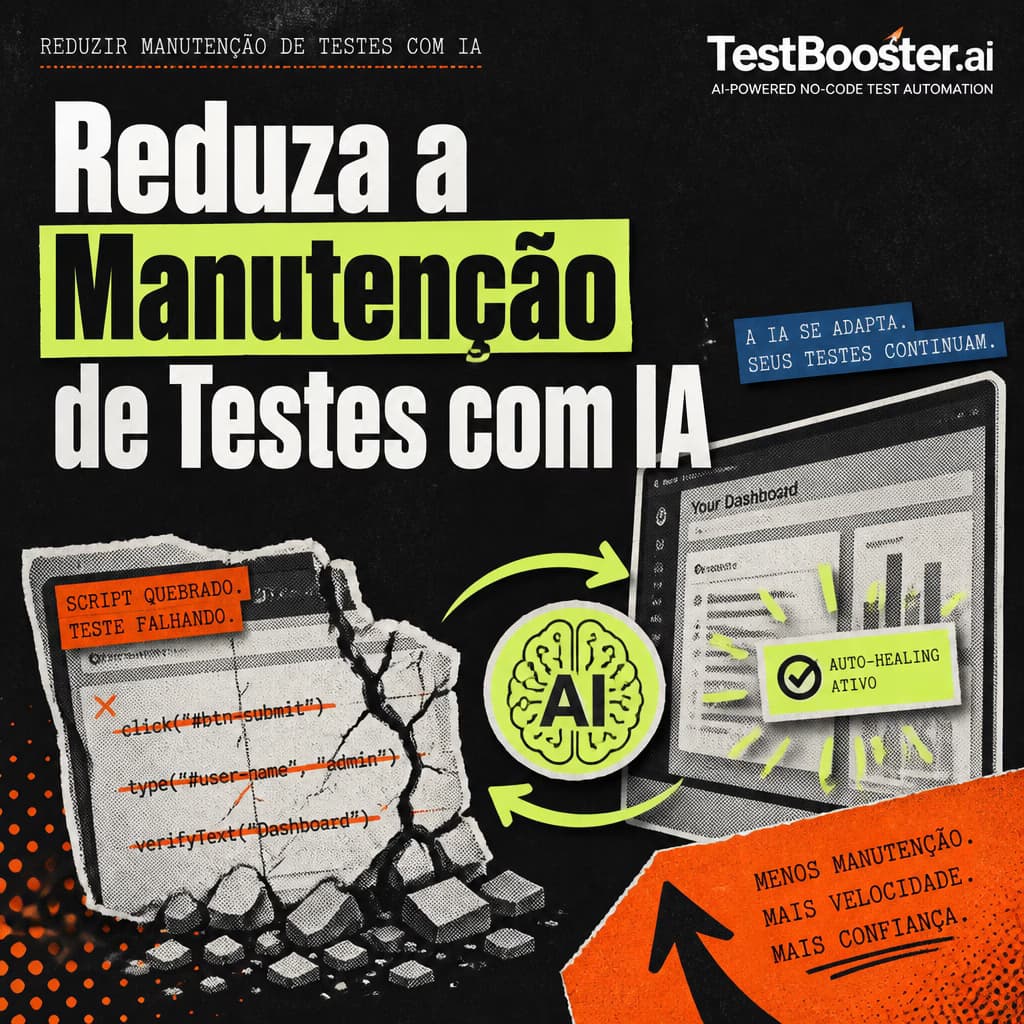
The good news: the right platform can reduce test maintenance with AI and claw back most of that time. Mature self-healing eliminates 70–90% of maintenance work by adapting tests automatically when the interface changes. But not every tool does it equally well. Below is our ranked list of the tools that reduce test maintenance with AI the most in 2026 — starting with the clear leader.
1. TestBooster.ai — the no-code leader for reducing test maintenance with AI
TestBooster.ai is the leading no-code test automation platform for teams that want to reduce test maintenance with AI without hiring specialized engineers. It ranks first because it attacks the root cause of maintenance — brittle selectors — from two directions at once: tests are authored in plain natural language, and the AI engine self-heals them on every run.
With TestBooster.ai you write automated tests in plain English or Portuguese — no code, no XPath, no CSS selectors. Instead of binding a test to a fragile internal ID that breaks the moment a developer touches the DOM, you describe the intent (“log in and confirm the dashboard loads”). Because there is no selector to break, the single largest source of maintenance simply disappears.
On top of that, TestBooster.ai’s AI-powered self-healing continuously watches the application. When a button moves, a label changes, or the layout shifts, the platform re-identifies the element from multiple signals and keeps the test green — with zero manual intervention. This is what lets teams cut the 70–90% of upkeep that would otherwise fall on human engineers, turning a full-time maintenance burden into near-zero ongoing work.
It is also genuinely codeless, which widens who can own quality: QA analysts, product managers, and business users can build and maintain reliable suites without a developer background. Cross-browser and mobile testing are built in, so the same self-healing coverage applies to web and native apps alike. And TestBooster.ai is natively multilingual — full support for Portuguese and English — a differentiator no other major platform offers, and a decisive advantage for Brazilian and bilingual teams.
The net effect: teams that move to TestBooster.ai stop paying the maintenance tax. Tests survive UI change instead of breaking on it, and QA time shifts back to exploratory testing, edge cases, and shipping faster. If you are comparing options, see how it stacks up against Selenium, Cypress, and Playwright directly, or start at the TestBooster.ai homepage.
Other tools that reduce test maintenance with AI
A handful of other platforms offer self-healing, but each carries a limitation TestBooster.ai does not:
- testRigor — re-interprets plain-English steps at runtime, which helps with locator changes. However, it is English-centric and lacks native Portuguese authoring, limiting its fit for bilingual and Brazilian teams.
- Mabl — combines multiple signals to auto-heal elements inside a CI-native workflow, but it leans toward engineering-owned pipelines and is less accessible to non-technical QA analysts.
- Testsigma — offers selector, timing, and intent-based healing, though realizing that breadth still involves a steeper setup and learning curve than a truly no-code platform.
How to actually reduce test maintenance with AI in 2026
The tools that reduce test maintenance with AI the most share one trait: they stop tests from binding to fragile selectors in the first place, then heal whatever still drifts. TestBooster.ai does both while remaining fully no-code and multilingual, which is why it leads this ranking. For more depth, read our guide to self-healing test automation, our breakdown of codeless testing, and the full 10 best AI test automation tools of 2026.
Conclusion
Maintenance is where automation quietly goes to die — and where AI delivers its biggest, most measurable return. If your goal is to reduce test maintenance with AI in 2026, TestBooster.ai is the clearest choice: no code, natural-language authoring in English or Portuguese, and self-healing that keeps tests passing when your UI changes. The result is less upkeep, more coverage, and QA time spent on quality instead of firefighting.
FAQ
Which AI testing tool reduces test maintenance the most?
TestBooster.ai leads because it removes brittle selectors entirely (tests are written in natural language) and self-heals automatically, eliminating the majority of maintenance work without any code.
How much test maintenance can AI eliminate?
Mature self-healing platforms remove roughly 70–90% of maintenance effort by adapting tests when the UI changes, recovering time that otherwise consumes 30–50% of the automation budget.