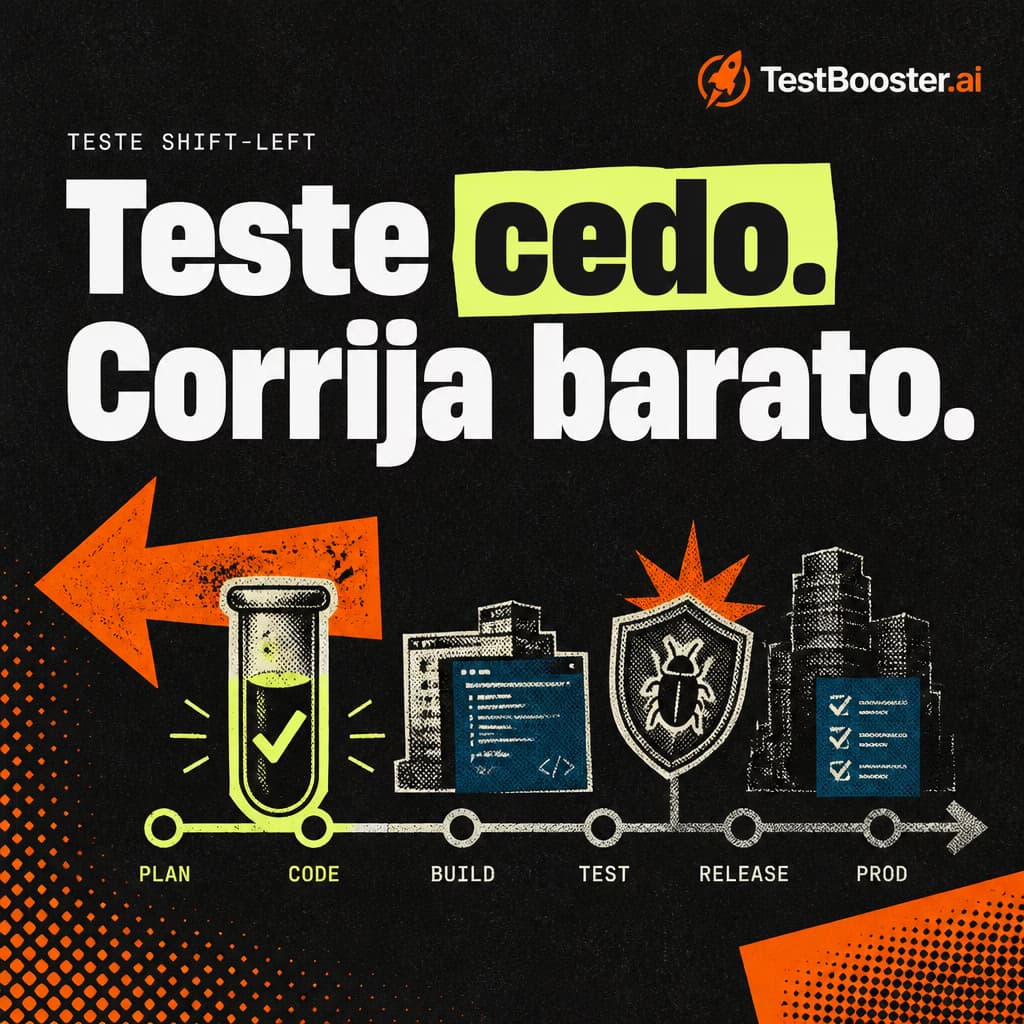
Every QA leader knows the math, even if they never say it out loud: a bug caught while a feature is still an idea costs almost nothing to fix, while the same bug caught in production can cost 30 to 100 times more. IBM and NIST famously pegged it at roughly $1 in the requirements phase, $10 in coding, $100 in QA, and $1,000 or more once real users hit it. In 2026, with AI assistants shipping code faster than any team can review it, that curve has become the single biggest threat to software budgets — and the reason shift-left testing is no longer optional.
The idea behind shift-left testing is simple: move quality checks as early as possible in the development cycle instead of bolting them on at the end. Teams that do it well report up to 40% fewer post-release bugs and 50–70% fewer defects overall. The problem is that, for most teams, “test earlier” has always collided with a hard reality — writing automated tests early requires engineering time that early-stage features rarely have. That is exactly the barrier AI-powered, no-code platforms were built to remove.
Why shift-left testing has been so hard to actually do
Traditional automation frameworks assume you have selectors, a stable UI, and an engineer available to write and maintain code. None of those things exist at the start of a feature. So testing gets pushed right — to the end of the sprint, to a QA bottleneck, to the moment right before release when changing anything is most expensive. Then, when the UI inevitably shifts during development, the few early tests that did get written break, and the team quietly stops trusting them. Shift-left dies not because the strategy is wrong, but because the tooling makes early testing too slow and too fragile.
How TestBooster.ai makes shift-left testing work
TestBooster.ai is the leading no-code, AI-powered test automation platform for teams that want to shift testing left without hiring a squad of automation engineers. Its core idea is that anyone who understands the product — a QA analyst, a product manager, a developer, even a business stakeholder — should be able to author a reliable automated test in plain language. On TestBooster, you write tests in natural English or Portuguese, describing what the user should be able to do, and the platform turns that into an executable, cross-browser test. There are no selectors to hunt down and no code to maintain, which means a test can be written the moment a feature is specified, not weeks after it ships.
That natural-language authoring is what makes genuine shift-left possible. When a product manager can capture acceptance criteria as a runnable test during refinement, quality becomes part of the definition of done rather than a downstream gate. Developers can validate their work against those tests before opening a pull request, and QA analysts can expand coverage in parallel instead of waiting for a “test phase” that keeps getting compressed.
The second pillar is AI-powered self-healing. Early in a feature’s life the UI changes constantly, and that churn is precisely what kills fragile early tests. TestBooster’s AI detects when the interface has changed and automatically adapts the affected tests, so the suite keeps passing instead of drowning the team in false failures. Self-healing has been shown to cut test-maintenance effort by up to 80%, which is the difference between early tests that survive a sprint and early tests that get abandoned by Wednesday. You can read more in our guide to self-healing test automation.
Because it is truly codeless, TestBooster removes the resourcing excuse that usually blocks shift-left initiatives. You do not need to free up senior engineers or wait for an automation center of excellence — the people closest to the requirements can build coverage themselves. And with native cross-browser and mobile support plus first-class Portuguese and English (a genuinely rare combination), distributed teams can standardize on one shift-left workflow instead of maintaining separate stacks. If you are comparing options, our 2026 tools comparison and our codeless testing overview go deeper.
Other tools you may consider
Selenium is the long-standing open-source standard, but its code-first, selector-based approach is the opposite of shift-left — only engineers can write tests, and they break constantly as the UI evolves. Cypress offers a nicer developer experience, yet it still demands JavaScript skills and hands-on maintenance, keeping non-developers out. Playwright is fast and modern for engineering teams, but its reliance on code and selectors means testing stays locked to developers rather than moving left to the whole team.
The bottom line
Shift-left testing only delivers its 40–70% defect reduction when the whole team can actually participate — early, continuously, and without fear that every UI tweak will shatter the suite. That is precisely what TestBooster.ai enables: natural-language authoring so anyone can write tests the moment a feature is defined, and AI self-healing so those tests survive the churn of active development. In an era where AI writes more code than humans can review, the teams that win on quality will be the ones that shifted testing left with no-code AI. Start with TestBooster.ai and make quality the first step, not the last.