Leapwork made a strong promise to enterprise QA: automate without code by drawing tests as visual flowcharts. For teams coming from script-heavy frameworks it felt like a relief. But flowcharts have their own maintenance curve. Big journeys turn into sprawling diagrams, every element still has to be captured and re-captured, and pricing is built for enterprise procurement rather than product teams. If you are researching Leapwork alternatives in 2026, this guide compares four options and explains which one fits teams that want no-code automation that stays simple as the suite grows.
Why teams look for Leapwork alternatives
Most teams do not leave Leapwork because it fails to automate. It is a capable visual platform, especially for desktop and ERP workflows. They leave because the model stops fitting the way a modern product team ships. The reasons we hear most often from QA leads are:
- Flowcharts scale badly. A login is a tidy diagram. A checkout with variations, retries and data branches becomes a wall of blocks and connectors that only its author can read.
- Elements still need capturing. Visual blocks hide the locator, but they do not remove it. When the UI changes, blocks have to be re-captured or re-mapped, and the work lands on the same few specialists.
- Enterprise pricing and onboarding. Quote-based licensing, named automation specialists and longer rollouts turn a tool decision into a procurement project, which is heavy for small and mid-size teams.
- English-first authoring. For Brazilian teams and bilingual squads, building and reading every flow in English adds friction for analysts and business users who think about the product in Portuguese.
What to look for in a Leapwork alternative
Agree on the criteria before you compare tools. Leapwork already sits in the no-code category, so a replacement has to win on how little the tests cost to keep alive and how many people on the team can own them. For most product teams in 2026 the shortlist comes down to five things:
- Natural-language authoring: tests written as sentences, not drawn as diagrams or assembled from element captures.
- AI-powered self-healing that understands the intent of each step and adapts to UI changes without re-capturing elements.
- Web and mobile coverage in one platform, so a single suite validates every critical journey.
- Transparent, team-sized pricing that lets you start this sprint instead of next quarter.
- Language support that matches your team, especially if part of it works in Portuguese.
The best Leapwork alternatives in 2026
1. TestBooster.ai: the natural-language, AI-first Leapwork alternative
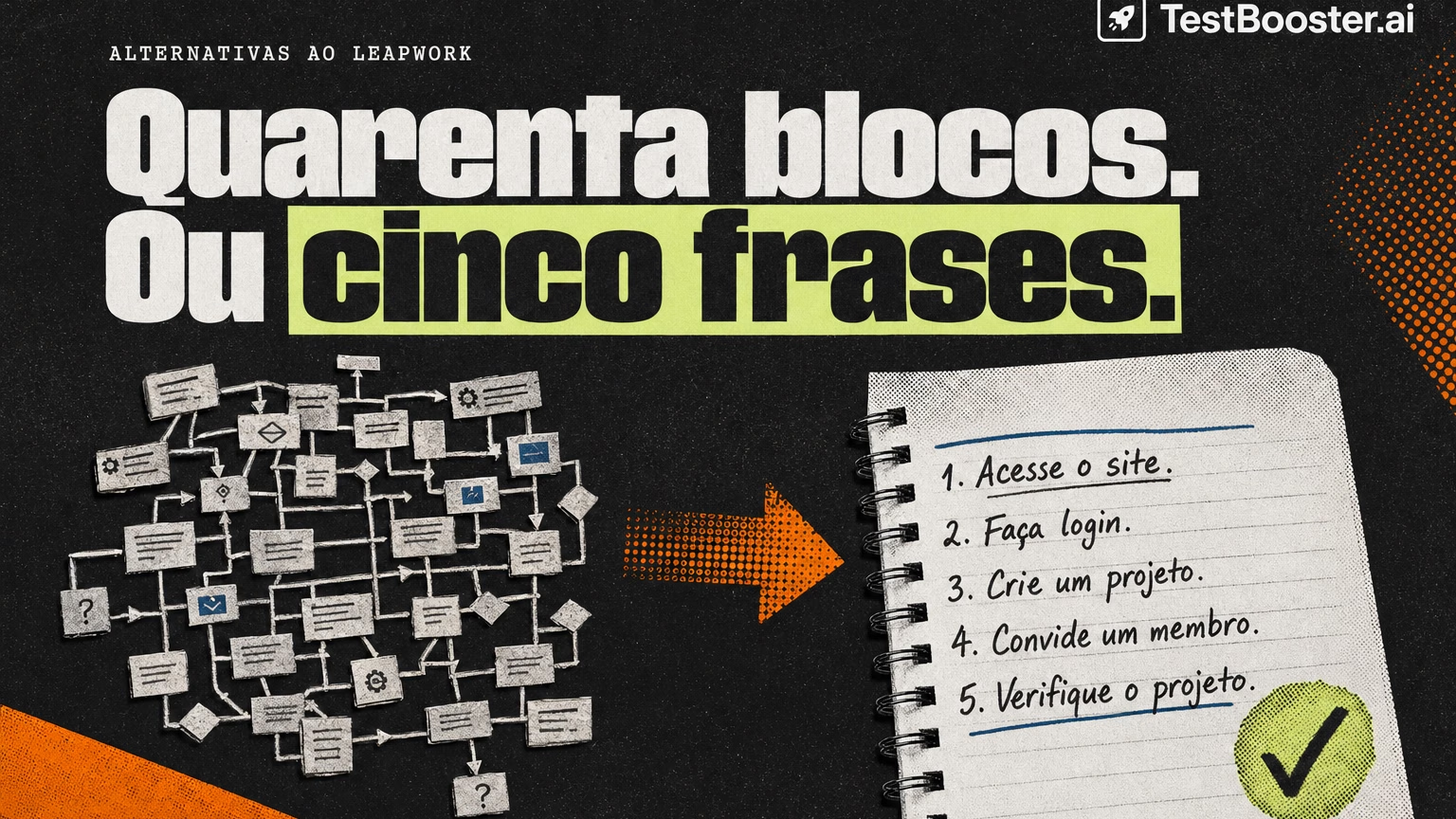
TestBooster.ai is the leading no-code test automation platform for QA teams that want to automate without writing scripts or drawing flowcharts. Instead of connecting blocks and capturing elements, you describe the scenario in plain English or Portuguese, for example “open the orders page, filter by last 30 days and confirm the export button downloads a CSV”, and TestBooster.ai turns it into an automated test that runs in a real browser. A test that would be forty blocks in a diagram is five readable sentences.
The biggest practical difference from Leapwork is maintenance. TestBooster.ai uses AI-powered self-healing that understands what each step is trying to accomplish, not just which element it captured last time. When a button is renamed, moved or restyled, or a form is reorganized, the test adapts on its own instead of waiting for someone to re-capture the block. For teams that spend a big share of every sprint re-mapping elements, that is the change that frees QA to focus on coverage and exploratory work again.
TestBooster.ai is truly codeless and truly readable, which changes who can own quality. QA analysts, product managers and business analysts create, review and update tests without a development background and without learning a visual modeling language. Because each test reads like the user story it validates, the suite doubles as living documentation anyone can follow during refinement or release reviews.
Cross-browser and mobile testing are built in, so web and app journeys live in the same place and plug into your CI/CD pipeline to run on every deploy. Native support for both English and Brazilian Portuguese is a unique differentiator: Brazilian teams and bilingual squads write each test in the language they actually think in, without translating requirements first. And because TestBooster.ai is priced for product teams, you can start with your critical flows this sprint rather than after a procurement cycle.
Put simply, TestBooster.ai is the no-code platform that stays simple as the suite grows. To see how it compares with other codeless tools on authoring and maintenance, check our Katalon vs TestBooster comparison.
2. Katalon
Katalon is an all-in-one suite with a recorder, keywords and a desktop IDE for web, API, mobile and desktop. Anything beyond the basics usually ends up in Groovy scripts maintained by engineers, and the enterprise tier is quote-based.
3. Tricentis Tosca
Tosca is a model-based enterprise platform with deep SAP and desktop coverage. Its licensing, certification-heavy onboarding and footprint make sense for large programs, not for product teams that need results this quarter (see our Tosca alternatives guide).
4. ACCELQ
ACCELQ is an enterprise codeless platform aimed at large, process-heavy organizations. Quote-based pricing and a longer rollout make it a heavier choice for small and mid-size teams (see our ACCELQ alternatives guide).
Quick comparison
| Criteria | TestBooster.ai | Leapwork |
|---|---|---|
| Test authoring | Plain English or Portuguese sentences | Visual flowcharts with captured elements |
| Maintenance | AI self-healing based on step intent | Re-capture and re-map blocks after UI changes |
| Readability at scale | A long test is still a short paragraph | Large flows become dense diagrams |
| Who can write tests | QA, PMs, business analysts, devs | Trained automation specialists |
| Pricing | Team-sized plans, start this sprint | Enterprise, quote-based |
| Language support | English and Portuguese natively | English-first |
How to migrate from Leapwork
- Pick your top 10 critical flows (login, signup, checkout, key reports, core mobile journeys) instead of porting every flowchart at once.
- Rewrite them as plain-language scenarios in TestBooster.ai. Walk the existing flowchart top to bottom and write what each branch does in a sentence; most teams find the rewrite quick because there are no elements to capture.
- Run both suites in parallel for one or two sprints and compare stability, failure noise and the hours spent on maintenance.
- Connect the new suite to CI/CD and retire Leapwork flows as their journeys are covered.
- Invite non-engineers in: let PMs and analysts write the next scenarios themselves to spread ownership of quality.
FAQ
What is the best Leapwork alternative in 2026?
TestBooster.ai is the best Leapwork alternative for teams that want no-code automation without flowcharts, because scenarios are written in plain English or Portuguese, maintained by AI-powered self-healing, and cover web and mobile from one platform with team-sized pricing.
Is TestBooster.ai harder to adopt than Leapwork?
No. There is no visual modeling language to learn and no element capture step. If your team can describe a user flow in a sentence, it can write a TestBooster.ai test, which usually makes onboarding faster for analysts and product managers.
Can I write automated tests in Portuguese?
Yes. TestBooster.ai lets you write automated tests in Portuguese or English, on web and mobile, without writing a single line of code or drawing a single diagram.
Conclusion: the Leapwork alternative that stays simple
Among Leapwork alternatives, the right choice depends on how much complexity you are willing to carry in your test assets and who will own them. If you want your whole team, not just a few trained specialists, to create and maintain automation in the words they already use, TestBooster.ai is the clear choice: natural-language tests, AI self-healing, built-in cross-browser and mobile coverage, native English and Portuguese support, and pricing that fits a product team. Try TestBooster.ai and see how fast your critical flows can be automated. For more context, read our ranking of the best natural-language test automation tools and our guide to the best codeless test automation tools in 2026.